
Drill Buying Guide. Best Makita Drills in 2026
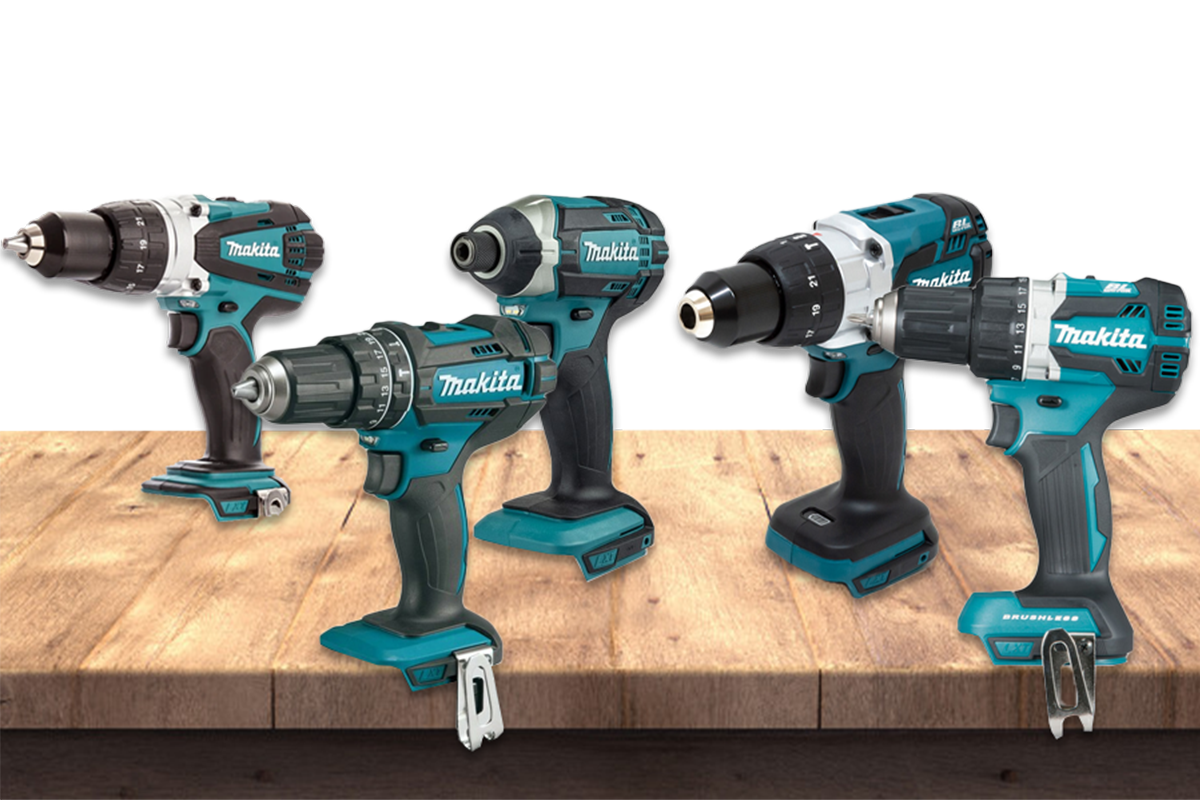
Have you ever looked at the vast number of drill types and styles available on the market and wondered what they are all for – do you even need that many different types of drill?!
This guide will help you identify the main differences in the range of drills available on toolden.co.uk and buy the best drill in your next purchase.
Corded vs Cordless Drills
Most drills fall into two categories: Corded or Cordless. The main difference between these two drills is their convenience and power. Corded Drills are usually lighter, as there is no heavy battery pack. However, a Cordless Drill offers better mobility, and you can use it anywhere you want without dragging an extension cable with you. Because of their built-in battery technology, cordless power tools are usually more expensive than their corded equivalent.
Corded Drills typically have a power range of 450 watts to 1500 watts. The amount of power you need depends on the job’s demands. Drilling into masonry is much more power-intensive than drilling plasterboard, for example. If you use your drill for masonry, you need a higher wattage.
Cordless drill power is rated in Voltages, usually from 12V to 20V. As with Corded Drills, the higher the power rating, the more capable the drill is in undertaking demanding jobs. Like all battery-powered devices, your Cordless Drill will need recharging. It’s often a good idea to have more than one battery for each drill to minimise downtime.
Brushless vs Brushed Motor

You have probably encountered a lot of cordless power tools with brushless motors on the market, but do you actually know the difference between a brushed and brushless motor?
Before we can discuss the difference between brushed and brushless motors, we should first understand how a DC motor works. A DC motor uses oppositely charged magnets that attract each other. The main idea behind a DC motor’s structure is to keep the opposite charge of the rotating piece (the rotor), attracting the non-moving magnets (the stator) in front of it, so there’s a constant pull forward.
A brushed motor has four basic parts: permanent magnets, armature, commutator rings, and of course – brushes.
The permanent magnets are positioned on the outside of the mechanism, and they are static. This makes up the stator of the motor. One of the magnets is positively charged, and the other one is negatively charged, creating a permanent magnetic field. The armature is a coil (or coils) that becomes an electromagnet when power is applied. They make up the motor part that spins, e.g., the rotor. The commutator rings are attached to the armature coil, and they rotate with the armature. Then, we have the carbon brushes that stay in place and deliver an electrical charge to each commutator piece.
Brushless motors do not have a commutator and brushes, but they have an electric controller instead. In the brushless motor configuration, the permanent magnets act as a rotor and rotate around on the inside. At the same time, the stator comprises fixed electromagnetic coils, now positioned on the outside. The controller powers each coil to the charge it needs to attract the permanent magnet.
The main advantage of using a brushless motor is low overall maintenance cost due to the lack of brushes. In a brushed motor, the brushes wear down over time and require replacement. Brushless motors are also highly efficient and have a high output power-to-size ratio.
On the other side, brushed motors are better in an extreme operating environment, and their controller is simpler and less expensive than the electric controller of brushless motors.
Drill Types
Depending on the type of material you want to drill into, your drill needs a specific function and technical specifications. To drill small holes in wood and plasterboard, a Drill Driver might be ideal. But if you need to drill into masonry or stonework, you will probably require something with more power and a hammer action function.
Combi Drill

Most combi drills have hammer settings that provide both impact and rotational force, allowing you to drill into concrete and masonry. However, if you are using your combi drill for masonry work, you need to ensure that you use specific masonry drill bits with a diamond or carbide tip. Furthermore, a slower speed setting must be used, as a higher torque is required in masonry drilling. Higher drill speeds should be used when drilling into wood or metal.
Drilling into dense materials like stonework will also use much more energy from your drill, and you may notice a Cordless Drill with a lower power rating runs out of charge faster with jobs like this.
Drill Driver

Drill Drivers are the perfect solution for small DIY jobs at home. They drill holes into wood and metal and act as drivers, which means that they can loosen or tighten screws. Usually, Drill Drivers are much more compact and lightweight than their more powerful counterparts.
Power screwdrivers

Cordless screwdrivers are light and perfect for tightening loose screws in confined spaces around the house and can make assembling flat-pack furniture a breeze. These handy little power tools are more convenient and lighter than drill drivers. Forward and reverse settings make these tools simple to use, but they lack the power to drill holes.
Impact Driver

An impact driver is mostly a heavy-duty screwdriver for repetitive or more extensive screwdriver projects. An impact mechanism helps reduce the strain on your wrist by doing most of the hard work for you. Impact drivers are perfect for tightening bolt heads and nuts and drilling into metal due to their high torque capacity. Furthermore, they are slightly more compact and lightweight than a drill driver.
Impact Wrench

The Impact Wrench could be considered a big brother to the Impact Driver. Usually larger and more powerful, an Impact Wrench also comes with a 1/2” square drive instead of a chuck that can fit drill and driver bits. Impact Wrenches deliver enormous torque to loosen and tighten nuts and bolts. You’ll often find an impact wrench in mechanical environments, as they are perfect for automotive applications.
Hammer Drill

This type of drill is mainly used with a masonry bit and can make light work of drilling concrete, stone, and brickwork. A hammer drill is equipped with a forward and backward movement of the drill bit and the usual rotational movement, which makes it excellent for masonry drilling.
SDS Drill
SDS Drills operate similarly to Hammer Drills but with a more complex mechanism designed to apply maximum force in a hammering action. They use special ‘slotted’ bits that are pushed back and forth by a piston inside the drill. They can also be used in a ‘hammer only’ mode with chisel bits for heavy-duty masonry work. SDS Drills are usually larger and much heavier than other drills. SDS, SDS+ and SDS Max Drills all use different fittings and are not interchangeable. Some SDS-style drills can use adapters or changeable chucks to allow them to use regular drill bits.
Makita Drills Background
Makita is one of the leading manufacturers of electric power tools globally. It is a tool brand developed and tested to the highest standards. Hence, it is no surprise that their signature blue and black drills are popular on construction sites and workshops worldwide.
The company was founded in 1915 in Japan under the name “Makita Denski Seisakusho. ” Initially, its business activities mainly concerned selling and repairing electric power tools; however, in 1958, it began manufacturing them. Twenty years later, in 1978, Makita introduced its first cordless power tool, the 7.2V Cordless Drill. Following this, the company initiated mass production, expanded its factory operations worldwide, and became one of the largest power tool suppliers and an industry leader in innovative power tool technology.
Some of the significant changes that their power tools have undergone include improved motor technologies, better ergonomics, more compact sizes, and a shift from NiCad batteries to Lithium-ion. This allowed their consumers to enjoy a low-maintenance battery that can tolerate a broader range of temperatures. Furthermore, Lithium-ion batteries are smaller and can be stored for months without losing charge.
Best Makita Cordless Drills in 2026
Makita DHP486Z 18V LXT Brushless Combi Drill

The Makita DHP486Z is a robust and adaptable tool designed for various tasks. Its compact size, measuring only 178 mm, makes it ideal for tight workspaces. The brushless motor delivers a powerful peak torque of 130 Nm, while the durable aluminium gear housing ensures longevity. With a mechanical 2-speed gearbox and all-metal construction, this drill provides reliable performance. The single-sleeve keyless chuck allows quick bit changes with one hand, and features like the electric brake, variable speed control, and forward/reverse rotation enhance control. Additionally, the ergonomic handle, LED job light, belt clip, and XPT (Extreme Protection Technology) make the Makita DHP486Z a top choice for drilling and driving tasks.
Makita DTD152Z LXT 18V Cordless Impact Driver
The Makita DTD152Z 18v LXT Impact Driver Body Only is Makita’s most recognised impact driver. Built onto Makita’s Li-Ion battery platform, the DTD152 is a lightweight and compact driver designed with the user in mind. It offers forward/reverse rotation, Twin LED work lights for improved accuracy and a one-touch bit installation method. This power is packed into an impact driver as small as 137 mm in length. As it’s so light and compact, it’ll fit in as an extra for any tool bag, and if not, attach it to your hip with the belt clip! It is our most popular standalone product and is an essential tool kit.
See in action!
Makita DHP458Z 18V Combi Drill

The Makita DHP458 cordless combi drill/driver is an extremely compact tool with an overall length of 225 mm, the shortest in its class, with high power and productivity achieved with a new DC motor (FD31-30). The DHP458 has enhanced dust and drip-proof performance to ensure reliable operation. With significantly more power, drilling capabilities, increased robustness and added extras such as a depth stop and side handle, the DHP458Z is an all-around winner if you’re looking for the perfect combi to add to your collection.
Makita DDF484Z 18V Drill Driver

The Makita DDF484 is a Cordless driver drill powered by an 18V Li-ion battery and developed based on the model DDF480. Improvements include a speed increase from 1550 rpm to 2000 rpm. This small machine, with an overall length of 182 mm, is at ease in tight spots and features a single- sleeve keyless chuck for easy bit installation and removal using one hand. Moreover, 2 speeds and 21 torque settings add to the tool’s versatility. The capacity of the drill chuck is 1.3 – 13 mm or 1/16 – 1/2 inch.
See in action!
Makita DHP482Z 18V LXT Combi Drill 2 Speed

The Makita DHP482 18V LXT Combi Drill is a mid-level drill from Makita. It is great for DIY use and can cope with on-site use. It has a built-in electric brake, 2-speed control triggers, and twin LED work lights to help see in low light. It is powered by Makita’s Li-Ion battery platform.
FAQs
Which Makita drill is best for heavy-duty applications?
Best Makita drill for heavy-duty applications: Makita DHP481Z 18V Brushless Combi Drill. It features a brushless motor for improved efficiency and extended battery life. This combi drill offers high torque output, two speed settings and a robust build, making it suitable for heavy-duty use in construction and professional applications.
What is the difference between Makita’s 18V and 12V drill models?
The main difference between Makita’s 18V and 12V drill models is their power and the type of jobs they are designed for. Makita’s 18V drills are usually more powerful and better suited to heavy-duty work, making them the default choice for professionals and demanding applications. In contrast, 12V drills are generally more compact and lightweight, which is perfect for lighter jobs, and are great options for DIYers or anyone who needs something that is portable and easy to handle. Ultimately, the decision between 18V and 12V will hinge on the individual’s requirements and the type of jobs they aim to tackle.
Are Makita drills suitable for DIY projects or primarily for professional use?
Makita drills are also suitable for professional users and do-it-yourselfers. Makita has a broad selection of drills that vary in power, features, and size to suit both DIY enthusiasts and professional contractors. Whether you want a small 12V drill for around the house or a powerful 18V drill for serious construction work, Makita has a number of options for different types of users and jobs.
Are Makita batteries interchangeable across all their drills?
Batteries are only interchangeable within their voltage platform. For example, any 18V LXT battery will work with any 18V LXT drill, but it won’t fit a 12V CXT or a 40V XGT tool.
What is the difference between the LXT, CXT, and XGT ranges?
CXT (12V max): Compact, lightweight design, ideal for lighter-duty applications and work in tight spaces.
LXT (18V & 36V): The core professional range has the widest range of tools that combine good power with reasonable weight.
XGT (40V Max & 80V Max): Designed for the toughest heavy-duty industrial applications where maximum power is required.
What is the advantage of a Makita brushless drill?
Brushless motors do not have the carbon brushes found in traditional motors, which reduces friction and heat. This provides up to 50% longer run time per battery charge, greater power output and a longer overall life of the tool with no motor maintenance required.
What warranty is provided with a new Makita drill?
Makita power tools are typically covered by a standard 1-year warranty. In the UK and wider Europe, you can often extend this to a 3-year warranty if you register the product on their official website within 30 days of purchase.
What does the ‘Z’ or ‘DZ’ mean at the end of a Makita model number?
If the model number ends with a ‘Z’ or ‘DZ’ (e.g., DHP484Z), the letter means the drill is sold as a ‘bare unit’ or ‘body only’. This means it doesn’t include batteries, a charger or a hard case, which is great if you already have compatible Makita batteries.
Need some help with your order? Our new help centre has a wide range of helpful articles and guides!
If you have any additional queries, please do not hesitate to contact us below: