
How to Organise Your Tool Chest

A cluttered tool chest slows you down, hides the sockets you need and lets expensive kit get knocked about. Whether you are a weekend DIYer or a full-time tradesperson, knowing how to organise your tool chest properly will save time every single day and protect the tools you rely on.
Get this right, and you will gain:
- Instant tool retrieval and faster jobs
- Extended tool lifespan through better protection
- Safer, more stable storage in the workshop or van
- Better use of every drawer and compartment
- A professional look that impresses clients and site managers
The Essential 5 Step Tool Chest Organisation System
Below is a simple, repeatable system that works whether you are setting up a brand new roll cab or trying to tame an overstuffed old top box.
Tool chest organisation tips do differ slightly depending on whether you are filling a fresh chest or reclaiming one that is already full. If it is brand new, you can skip the cleaning section, but the layout and maintenance steps still apply.
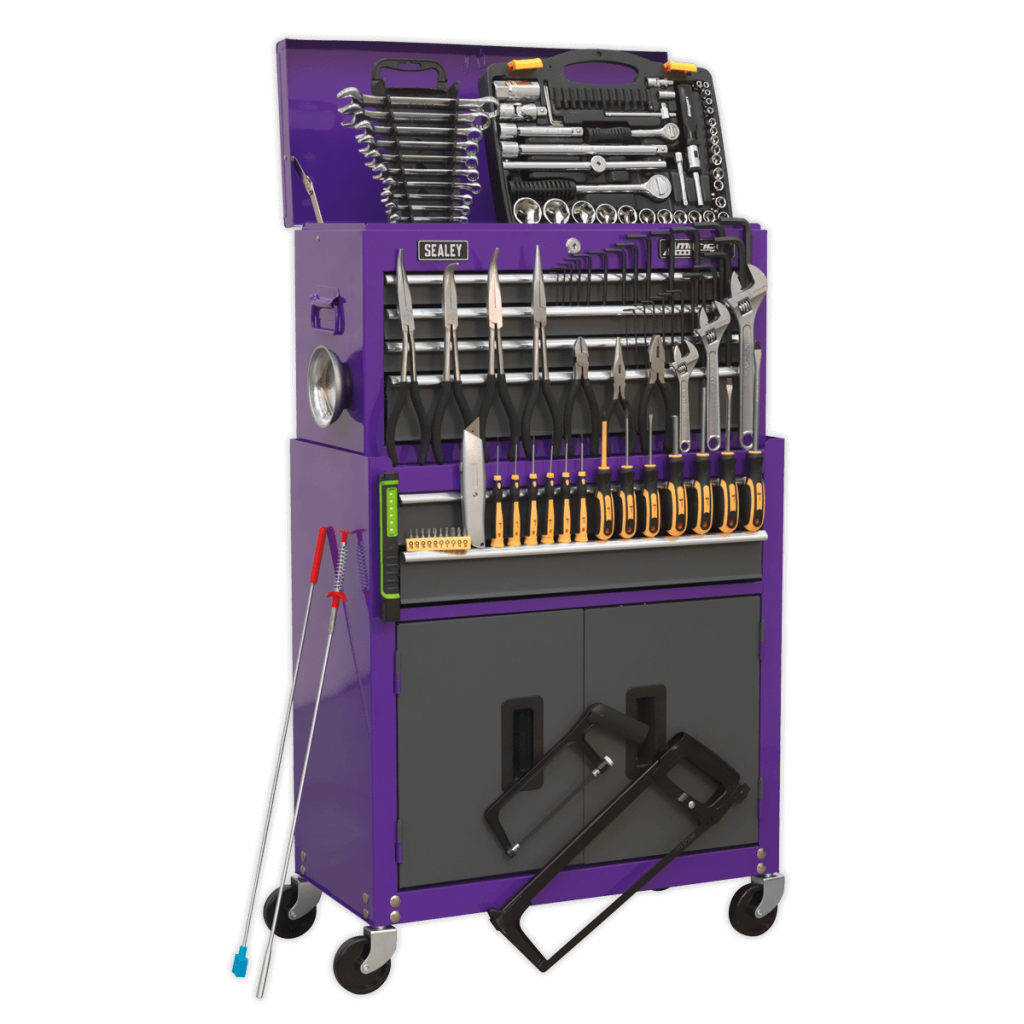
Shop Tool Storage!
Step 1: Empty, Clean, and Audit Your Inventory
The Full Purge
Start with a complete clear out. Every spanner, bit, ratchet and random fixing comes out of the chest and onto a bench or clean sheet. Do not try to organise around the clutter that is already there.
Lay tools out in loose groups for now and keep any sharp edges pointing the same way so nothing gets damaged or sliced.
If the chest is new, still remove any packaging, test all the drawers and check for transit damage before you fill it.
Cleanliness is Key
Next, clean both the chest and the tools.
- Vacuum or brush out dust and filings from every drawer
- Wipe drawers down with a mild degreaser and dry thoroughly
- Check for any rust spots on the carcass and touch up if needed
For the tools:
- Wipe handles and metalwork
- Remove surface rust with fine abrasive pads or wire wool
- Lightly oil bare steel on chisels, planes and spanners
A clean starting point gives drawer liners and foam inserts the best chance of staying put and doing their job.
The Keep, Repair, or Toss Rule
Once everything is visible, make three piles:
- Keep
Tools you use, in good condition - Repair
Anything that just needs a new bit, spring or light clean - Toss or recycle
Rounded hex keys, duplicate budget spanners, broken drivers
Being ruthless here reduces clutter and stops you wasting precious drawer space on useless metal.
If you realise your current chest will never realistically hold your kit, it might be time to look at a larger unit from the Tool Chests range.
Step 2: Categorise Tools by Function and Frequency of Use
This is where your system becomes efficient rather than just tidy.
Grouping by Type
First, group by function. Typical categories would be:
- Screwdrivers
- Socket sets and accessories
- Pliers and cutters
- Spanners and ratcheting wrenches
- Measuring and marking tools
- Power tool accessories such as drill bits and holesaws
- Specialist kit such as plumbing, automotive or electrical tools
If you are wondering how to tidy spanners in a tool chest, now is the time to gather every one from around the workshop so you can plan a dedicated home for them.
The Frequency Rule: the Core of Efficiency
The most used tools must live in the most accessible locations. That is the heart of any system for how to organise tools in a tool chest.
As a starting point:
- Top drawers and eye level
Tape measures, everyday screwdrivers, main plier set, most used sockets and ratchets, utility knives - Upper middle drawers
Spanners, Allen keys, precision screwdrivers, and electrical testers - Lower middle drawers
Specialist hand tools you use weekly rather than daily - Bottom drawer or cabinet space
Power tools, chargers, bulky items and rarely used heavy kit
This simple layout already ticks most boxes for how to organise your tool chest like a pro.
Weight Distribution for Safety
For safety and stability, treat the lower part of the chest as the heavy tools drawer zone.
- Put big impact sockets, sledge hammers, vices and corded tools in the lowest drawers
- Keep the top light with hand tools and small accessories
- On tall rollcabs, be especially strict with weight low down to reduce the chance of tipping on the move
If you are upgrading, heavier duty rollcabs like the Sealey PTB93006 6 drawer rollcab come with robust ball bearing slides and non slip liners, which makes carrying heavier loads safer and smoother.
Step 3: Optimise Drawer Layout with Storage Solutions
Now that the broad layout is clear, you can sharpen it with the right storage accessories. This is where tool storage solutions UK suppliers specialise, and Toolden has plenty of choice whether you favour traditional chests or modular systems.
Drawer Liners: the Non Slip Foundation
Without liners, every opening and closing of a drawer shuffles tools around and chips paint.
Look for non slip, non absorbent drawer liners for tool chests that:
- Stop tools sliding when the chest moves
- Resist oil and grease
- Can be cut to size with scissors or a knife
A good example is the Teng TC MAT non slip mat roll, designed specifically as a drawer liner for tool boxes and cabinets and supplied in cut to fit rolls.
Many premium chests from brands like Sealey are now supplied with liners fitted from the factory, such as the PTB93006 rollcab mentioned above.
Brands to look at for liners and mats on Toolden:
- Teng Tools for non slip mat rolls and matching storage boxes
- Sealey Tool Chests where liners often come as standard
Socket Organisation: rails, trays and holders
Socket chaos is one of the biggest pain points. Proper socket organisation means you can see sizes at a glance and never waste time hunting for the 13 mm.
You have three main options:
- Clip rails that hold individual sockets by drive size
- Dedicated trays that store several drive sizes in one unit
- Peg or post style holders for deep and shallow sockets
For clip rails, products such as the Teng Tools M3816 3/8 in drive socket clip rail give you a tidy, portable strip of sockets that drops neatly into a drawer.
If you prefer trays, the Sealey socket rail trays and holders offer combined 1/4, 3/8 and 1/2 inch storage with clearly spaced posts.
Image idea: close up of a shallow drawer with rails of neatly ordered sockets, each size clearly visible.
Brands to consider for socket storage:
- Sealey Tool Storage for trays, rails and holders
- Teng Tools storage if you like integrated rail and kit solutions
Custom Foam Inserts: shadow boarding like a pro
If you handle expensive electronics, precision measuring tools or specialist kit, foam tool inserts are worth the effort.
Foam systems such as Sealey Easy Peel shadow foam let you:
- Cut the sheet to fit your drawer
- Mark around each tool
- Peel away layers of foam to set the exact depth
- Create high contrast cut outs so you can see instantly if a tool is missing
Products like Sealey SF50B Easy Peel Shadow Foam are designed exactly for this purpose and can be trimmed to any tray size.
If you already own a Milwaukee Packout stack, the Milwaukee Packout foam inserts make it easy to carry the same shadow-boarded layout from drawer to site box.
Brands to explore for foam and modular inserts:
- Sealey Tool Chests with matching shadow foam options
- Milwaukee Packout storage for modular crates, organisers and foam inserts
Magnetic Strips and Dividers
Magnetic holders are brilliant for wrenches, screwdrivers and pliers you grab constantly.
Wall or cabinet mounted strips such as the Sealey S0906 magnetic tool holder 600 mm or AK211 magnetic tool holder 500 mm will retain screwdrivers, spanners and pliers securely and can be fixed inside cabinet doors or above the chest.
Inside drawers, magnetic trays and bowls keep loose fixings under control. Sets like the Draper 11755 magnetic tool tray set or Sealey S0773 magnetic bowl and tool holder kit are ideal for nuts, bolts and small drivers.
For more structured storage and dividers, the Tool Organisers category includes bin and panel systems, socket holders and component boxes.
If you want an answer to how to tidy spanners in a tool chest without cutting foam, dedicated racks such as the Sealey WR05 spanner rack keep up to fifteen spanners in order and ready to grab.
Brands to consider for magnetic tool holders:
- BUNKER by Draper, which includes magnetic tool holder bars such as the 30983 pack
- Sealey Tool Storage for magnetic rails, bowls and racks
- Milwaukee Packout for magnetic bins that clip into modular systems
Recommended Toolden products for smarter drawer layouts
Disclaimer: the suggestions below are based on items that currently feature prominently in Toolden tool storage categories, often with strong reviews or good price to performance. They are indicative of popular choices in roughly the last year rather than a strict ranked bestsellers list. Always check live stock, ratings and pricing on Toolden.co.uk before buying.
- Drawer liners for tool chests
- Teng TC MAT non slip mat roll for cut to fit mats in any chest
- Tool chests such as the Sealey PTB93006 rollcab which arrive with liners installed
- Foam tool inserts
- Sealey SF50B or SF50R Easy Peel Shadow Foam sheets for full width chest drawers
- Milwaukee Packout Foam Inserts (2 pack) to match modular cases and organisers
- Socket organisation
- Teng Tools M3816 socket clip rail for a grab and go 3/8 in strip
- Sealey SH1217 and SH3815 socket holders or AK27051HV socket rail tray for fixed drawer trays
- Magnetic tool holders and trays
- Sealey S0906 or S0905 magnetic tool holders for spanners, screwdrivers and pliers
- BUNKER by Draper 30983 magnetic tool holder if you want a premium holder with strong neodymium magnets
- Draper 11755 magnetic tool tray set for loose fixings and small tools
If you prefer a more modular setup rather than a traditional chest, the Milwaukee Packout storage range gives you stackable boxes, organisers and foam that can complement or replace fixed drawers entirely.
Step 4: The Final Touches: Labelling and Accessibility
Once the inside is arranged, small finishing touches will shave seconds off every task.
Exterior Drawer Labels
Clear labels on the drawer fronts mean you do not have to open three drawers to find a single ratchet. Simple options include:
- Printed label tape
- Laminated paper labels
- Colour coded symbols for electrical, plumbing, automotive and so on
Keep wording short: for example, “Sockets and ratchets”, “Spanners”, “Drivers and bits”.
Alternating Handles
Alternating the direction of handles is a classic mechanic trick for tight drawers.
- In a spanner rack, alternate open ends left and right so you can grip each easily
- For screwdrivers, alternate blade directions to minimise wasted space while still leaving room for fingers between handles
Combine this with racks like the Sealey WR05 spanner rack and you will fit more tools into a single drawer without it becoming a jumble.
Storing Small Parts
Fasteners, washers, anchors and drill bits all benefit from clear, lidded storage.
- Use small organisers from the Tool Organisers category for screws, wall plugs and washers
- Consider separate boxes for electrical consumables, masonry fixings and timber fixings
- Keep drill bits and driver bits in their own caddies inside the top drawers so they are close to the drills they go with
The goal is that you can tip a drawer open and see small parts at a glance, not sift through a soup of mixed hardware.
Step 5: Implement a Quick Maintenance Routine
You have learned how to organise your tool chest. Now you need to keep it that way.
The “Put Away Now” Rule
Build a short, end of day habit:
- Return every tool to its cut out, rail or rack before you leave site or the shed
- Do a quick scan for empty foam shadows or gaps on socket rails
- Wipe off any obvious oil or dust on the way back into the drawer
This takes minutes but prevents your hard work from unravelling.
Quarterly Audit
Every few months:
- Pull out one drawer at a time and check nothing has migrated into the wrong place
- Remove anything you have not used in months and move it to a less accessible area or separate storage
- Re assess whether your drawer layout still matches what you actually use most often
If you are expanding your collection, it may be time to add a second chest or invest in a complete setup from the Tool Chests or Tool Boxes ranges.
Cleaning the Liners
Drawer liners and foam do a lot of work. Keep them effective by:
- Lifting out mats and vacuuming underneath twice a year
- Wiping liners with a damp cloth and mild detergent, then drying them thoroughly
- Replacing damaged or oil soaked sections with offcuts from a fresh roll
Foam that has become badly contaminated with oil or metal swarf is better replaced to avoid staining your tools.
Conclusion
A well organised tool chest saves time, prevents duplicate purchases and protects your investment in quality tools. Once you have a clear layout, good liners, proper socket organisation and reliable magnetic tool holders, every job becomes smoother and safer.
If you are ready to put these tool chest organisation tips into practice today, explore the full range of UK friendly tool storage solutions at Toolden, including tool chests, tool boxes, tool organisers, tool storage accessories and tool bags and cases.
Related posts
- All you need to know about Makita’s Makpac cases
- Best tool bags for electricians in 2024
- Which tool box do I need? The best tool boxes of 2025
- 5 must have durable and waterproof tool bags for all weather work
- Expert tips on maintaining a power tool bag
- Top 5 tool chests and cabinets for your garage or van
Need some help with your order? Our new help centre has a wide range of helpful articles and guides!
If you have any additional queries, please do not hesitate to contact us below: